
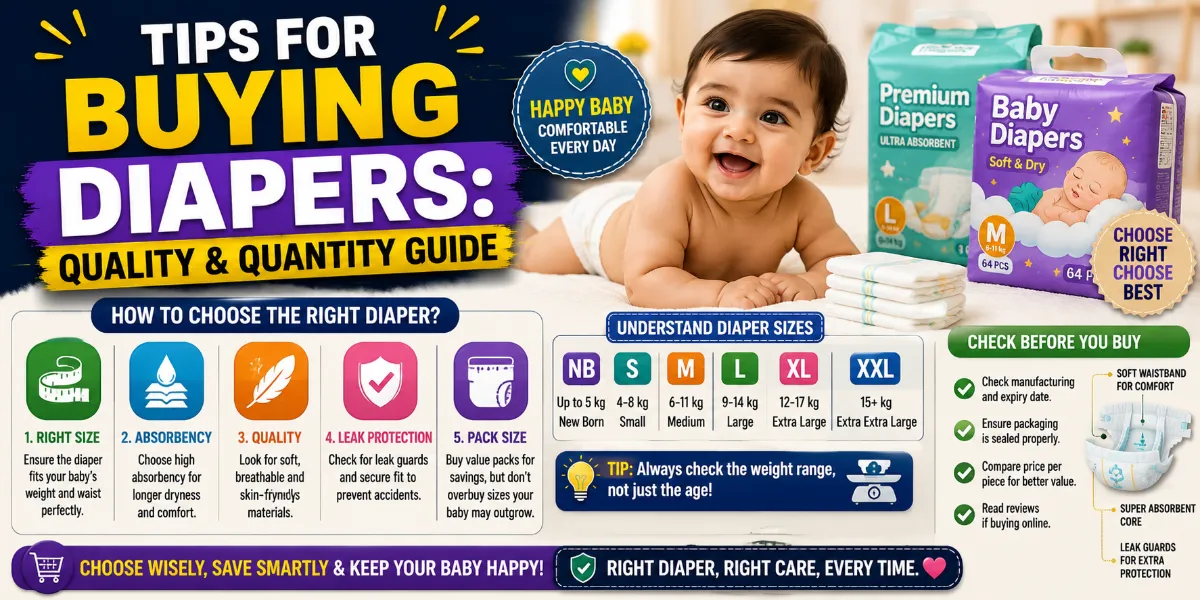
Tips for Buying Diapers: Quality and Quantity Guide
Becoming a parent is one of the most beautiful experiences in life. But it also comes with challenges that no one warns you about. One of those challenges is buying diapers. Yes, diapers. It sounds simple enough, but if you have ever stood in the diaper aisle, staring at rows upon rows of colorful packages, you know exactly what I am talking about.
Which size should you buy? How many do you need? Which brand is best? Should you go for the cheapest option or the most expensive one? What about sensitive skin? These questions can be overwhelming, especially for new parents who are already sleep-deprived and stressed.
The truth is, buying diapers is not as simple as grabbing the first package you see. The wrong choice can lead to leaks, rashes, discomfort for your baby, and wasted money. But when you choose the right diaper, your baby stays comfortable, happy, and dry all day. And that makes parenting just a little bit easier.
This guide is designed to help you navigate the confusing world of diapers. It covers everything from choosing the right size and absorbency to understanding quantity and avoiding common mistakes. Read this before your next purchase. Your baby and your wallet will thank you.
The Importance of Choosing the Right Diaper
Before we dive into the specifics, let us talk about why choosing the right diaper matters so much.
Comfort. Your baby spends most of their time in a diaper. If it is not comfortable, they will be fussy and irritable. A well-fitting diaper allows your baby to move freely, sleep peacefully, and enjoy their day.
Skin Health. Babies have delicate, sensitive skin. The wrong diaper can cause redness, rashes, and even painful infections. Good quality diapers are designed to keep moisture away from the skin, reducing the risk of diaper rash.
Leak Protection. There is nothing worse than a diaper that leaks. It ruins your baby's clothes, your furniture, and your day. A good diaper has strong absorbency and a secure fit that prevents leaks.
Cost-Effectiveness. Diapers are a recurring expense. Buying the wrong type can mean changing your baby more frequently, which wastes money. Choosing the right diaper saves you money in the long run.
Peace of Mind. When you know your baby is comfortable and protected, you can relax and enjoy parenthood. You do not have to worry about constant leaks or rashes.
Step 1: Choosing the Right Size
The most common mistake parents make is buying the wrong size. This is understandable because babies grow so quickly. But choosing the correct size is essential for comfort and leak protection.
How Diaper Sizes Work
Diaper sizes are typically based on your baby's weight. However, weight is not the only factor. You also need to consider your baby's shape. Some babies have chunky thighs, while others have a round tummy. The fit should be snug but not too tight.
Here is a general guide to diaper sizes based on weight.
Newborn (Size N): Up to 4.5 kg (10 lbs). This is for the first few weeks of life. Newborn diapers have a cut-out for the umbilical cord stump.
Size 1: 4 to 6 kg (8 to 14 lbs). This is usually for babies from newborn to about 3 months.
Size 2: 5 to 8 kg (12 to 18 lbs). This fits babies from about 3 to 6 months.
Size 3: 7 to 13 kg (16 to 28 lbs). This is a common size that fits babies from about 6 months to 1 year.
Size 4: 9 to 17 kg (22 to 37 lbs). This is for toddlers and fits from about 1 to 2 years.
Size 5: 12 to 19 kg (27 to 42 lbs). This is for older toddlers.
Size 6: 15+ kg (35+ lbs). This fits older toddlers and potty-training children.
Signs Your Diaper Size Is Wrong
Here are some signs that your baby's diaper is the wrong size.
Signs It Is Too Small:
Red marks on your baby's thighs or tummy.
The diaper does not cover the bottom completely.
The tabs do not reach the front of the diaper.
Frequent leaks or blowouts.
Your baby seems uncomfortable or fussy.
Signs It Is Too Big:
The diaper is loose and saggy.
Gaps around the legs or waist.
The tabs are overlapping or not sticking properly.
Frequent leaks because the diaper is not snug against the body.
Tips for Sizing
Trust the Weight Guidelines. Use the weight guidelines as a starting point. But remember, every baby is different.
Check the Fit Regularly. Babies grow quickly. Check the fit of the diaper every few weeks. If you notice any of the signs above, it is time to move up a size.
Consider Your Baby's Shape. If your baby has chunky thighs, you may need to size up even if they are within the weight range for the current size. If your baby has a slim build, you may be able to stay in the smaller size longer.
Do Not Buy Too Many in One Size. Babies grow fast. You do not want to be stuck with a large box of diapers that your baby has outgrown.
Step 2: Understanding Absorbency
Absorbency is the most important feature of a diaper. After all, the whole point of a diaper is to keep your baby dry. But not all diapers are created equal when it comes to absorbency.
What Determines Absorbency?
The absorbency of a diaper depends on the materials used. Most modern diapers use a combination of fluff pulp and superabsorbent polymer (SAP). The SAP is a gel-like substance that can absorb many times its weight in liquid. It traps the moisture and locks it away from your baby's skin.
How Much Absorbency Do You Need?
The amount of absorbency you need depends on several factors.
Your Baby's Age. Newborns urinate frequently, but in small amounts. Older babies and toddlers urinate less frequently but in larger amounts.
Day vs. Night. You need a diaper with higher absorbency for nighttime because your baby will be in the diaper for longer periods.
Activity Level. Active babies who are crawling or walking need a diaper that can absorb quickly and prevent leaks even when they are moving around.
Gender. Some parents find that boys and girls wet their diapers in different areas. Some brands offer gender-specific diapers, which are designed to place the absorbent material where it is needed most.
Types of Diapers Based on Absorbency
Standard Absorbency. These are suitable for daytime use for babies who are changed frequently. They are usually the most affordable option.
Max Absorbency or Overnight Diapers. These are designed for nighttime use or for babies who are heavy wetters. They have extra absorbent material and often have added features like extra leak guards.
Regular vs. Premium. Some brands offer different tiers of absorbency within the same size. Premium diapers usually have better absorbency and softer materials.
Step 3: Understanding Quantity – How Many Diapers Do You Need?
One of the most common questions new parents ask is "How many diapers do I need?" The answer depends on your baby's age and how often you change them.
Average Diaper Usage by Age
Here is a general guide to how many diapers your baby will use per day.
Newborn (0 to 1 month): 10 to 12 diapers per day. Newborns need to be changed frequently because they urinate often and their skin is very sensitive.
Infants (1 to 5 months): 8 to 10 diapers per day. As babies get older, they urinate less frequently but in larger amounts.
Older Babies (6 to 11 months): 6 to 8 diapers per day. At this stage, you may also start using overnight diapers.
Toddlers (12 to 24 months): 5 to 6 diapers per day. You may start potty training during this period, which will reduce the number of diapers you need.
How to Calculate Monthly Quantity
To estimate how many diapers you need for a month, multiply the daily average by 30.
Newborn: 10 to 12 per day x 30 = 300 to 360 diapers per month.
Infant (1-5 months): 8 to 10 per day x 30 = 240 to 300 diapers per month.
Older Baby (6-11 months): 6 to 8 per day x 30 = 180 to 240 diapers per month.
Toddler (12-24 months): 5 to 6 per day x 30 = 150 to 180 diapers per month.
Tips for Stocking Up
Buy in Bulk. Buying diapers in bulk is usually cheaper per diaper. Larger packs or boxes offer better value.
Do Not Overstock. While buying in bulk is cost-effective, do not buy too many of one size. Babies grow quickly, and you do not want to be left with a large pack of diapers that no longer fit.
Consider Your Storage Space. Diapers take up a lot of space. Make sure you have adequate storage before buying in bulk.
Stock Up on Different Sizes. If you see a good deal, you can stock up on different sizes to be prepared for your baby's growth.
Step 4: Quality Considerations – What to Look For
Not all diapers are the same. There are significant differences in quality between brands. Here are some factors to consider when evaluating quality.
Material Softness
Diapers should be soft and gentle against your baby's skin. High-quality diapers use soft, non-woven materials that feel comfortable. Cheaper diapers may use rougher materials that can cause irritation.
Breathability
Diapers need to be breathable to prevent heat rash. Look for diapers that have breathable outer covers. These allow air to circulate, keeping your baby's skin dry and comfortable.
Wetness Indicator
Many premium diapers have a wetness indicator. This is a line on the diaper that changes color when the diaper is wet. It takes the guesswork out of checking if your baby needs a change. This is especially useful for new parents.
Stretchability and Fit
The diaper should have stretchy side panels that allow for a snug fit. This helps the diaper move with your baby. It also prevents leaks because the diaper stays in place.
Leak Guards
Good diapers have leak guards, also called leg cuffs. These are elasticized barriers around the legs that help contain messes. They are especially important for preventing blowouts.
Absorbent Core
Look for diapers with a well-distributed absorbent core. This ensures that the liquid is absorbed evenly and does not create uncomfortable lumps.
Hypoallergenic
If your baby has sensitive skin, look for diapers labeled as hypoallergenic or dermatologically tested. These are free from fragrances, dyes, and harsh chemicals that could cause irritation.
Fragrance
Some diapers are scented. While this can make the diaper smell better, the fragrances can irritate sensitive skin. It is best to choose unscented diapers, especially for newborns.
Step 5: Common Mistakes to Avoid When Buying Diapers
Many parents make mistakes when buying diapers. Here are some of the most common ones.
Buying Only the Cheapest Option. The cheapest diapers are often the lowest quality. They may leak, cause rashes, and need to be changed more frequently. In the long run, you may end up spending more money because you are going through more diapers.
Buying Too Many of One Size. Babies grow fast. You do not want to be stuck with a large pack of diapers that no longer fit.
Not Reading the Packaging. The packaging contains important information, including the weight range, the number of diapers, and the features. Always read the label.
Ignoring Your Baby's Reaction. Every baby is different. A diaper that works well for one baby may not work for another. Pay attention to how your baby responds to a particular brand.
Changing the Diaper Too Late. Even the best diaper will cause a rash if you leave it on for too long. Change your baby regularly.
Stocking Up on a New Brand Without Testing. Before buying a large quantity of a new brand, buy a small pack first. Test it out for a few days. If it works well, then you can stock up.
Disposable vs. Cloth Diapers
Many parents also face the choice between disposable and cloth diapers. Here is a quick comparison.
Disposable Diapers
Pros:
Convenient and easy to use.
Highly absorbent.
Great for travel.
No washing required.
Cons:
Expensive over time.
Environmental impact.
Can cause skin irritation for some babies.
Cloth Diapers
Pros:
Cost-effective in the long run.
Environmentally friendly.
Less likely to cause rashes.
Available in a wide variety of designs.
Cons:
Require washing and drying.
Less absorbent than some disposables.
More prone to leaks if not fitted properly.
Higher initial cost.
Many parents choose to use a combination of both. They use cloth diapers at home and disposables for travel and nighttime. The choice depends on your budget, lifestyle, and preferences.
How to Treat and Prevent Diaper Rash
Even with the best diapers, diaper rash can still occur. Here are some tips to prevent and treat it.
Change Diapers Frequently. Do not leave a wet or soiled diaper on for too long.
Keep the Area Clean. Clean your baby's bottom with warm water and a soft cloth. Avoid using wipes with alcohol or fragrance if your baby has sensitive skin.
Pat Dry. Do not rub the skin. Pat it dry with a soft cloth.
Apply a Barrier Cream. Use a diaper rash cream or petroleum jelly to create a barrier between the skin and the diaper.
Allow the Skin to Breathe. Give your baby some time without a diaper. This allows the skin to dry completely.
Use the Right Size. A too-tight diaper can cause chafing and irritation.
Change Brands. If the rash persists, the diaper may be the cause. Try switching to a different brand.
Why Trust Malik Fayaz Traders for Your Baby's Diaper Needs
At Malik Fayaz Traders, we understand that your baby's health and comfort are your top priorities. That is why we offer a carefully selected range of high-quality diapers from trusted brands.
We understand that every baby is unique. Different babies have different skin sensitivities and needs. That is why we offer a variety of options, including hypoallergenic and sensitive skin diapers. We also carry different sizes and absorbency levels.
We offer free delivery in Burewala city. You can order diapers from the comfort of your home and receive them at your doorstep. Our team ensures that your order is handled with care and delivered promptly.
We believe in providing value for money. Our diapers are priced competitively, and we offer bulk packs to help you save money